From ambiguous requests
to verifiable delivery.
These pages explain how Delivery Harness Framework (DHF) turns agentic engineering work into fact recovery, domain and ADR alignment, lifecycle routing, verification evidence, and recoverable handoff.
DHF routes decisions before work starts
The public guide now reflects the current skill contract: recover state, classify execution lane, resolve architecture conflicts, choose the specialist route, and finish with fresh evidence.
Local, demo, or production
DHF separates local development, operator live demo work, and customer or production paths so external systems, secrets, deploys, and customer data stay approval-gated.
Architecture checkpoint
When durable sources disagree, DHF captures a decision-focused checkpoint, recuts vertical slices around outcomes, and validates agent-team write sets before dispatch.
Committee loops are explicit
Ordinary review, QA, security, and design routes stay specialized. Committee loops run only when the user asks for reviewers, a revision worker, and a target score.
Learn the framework
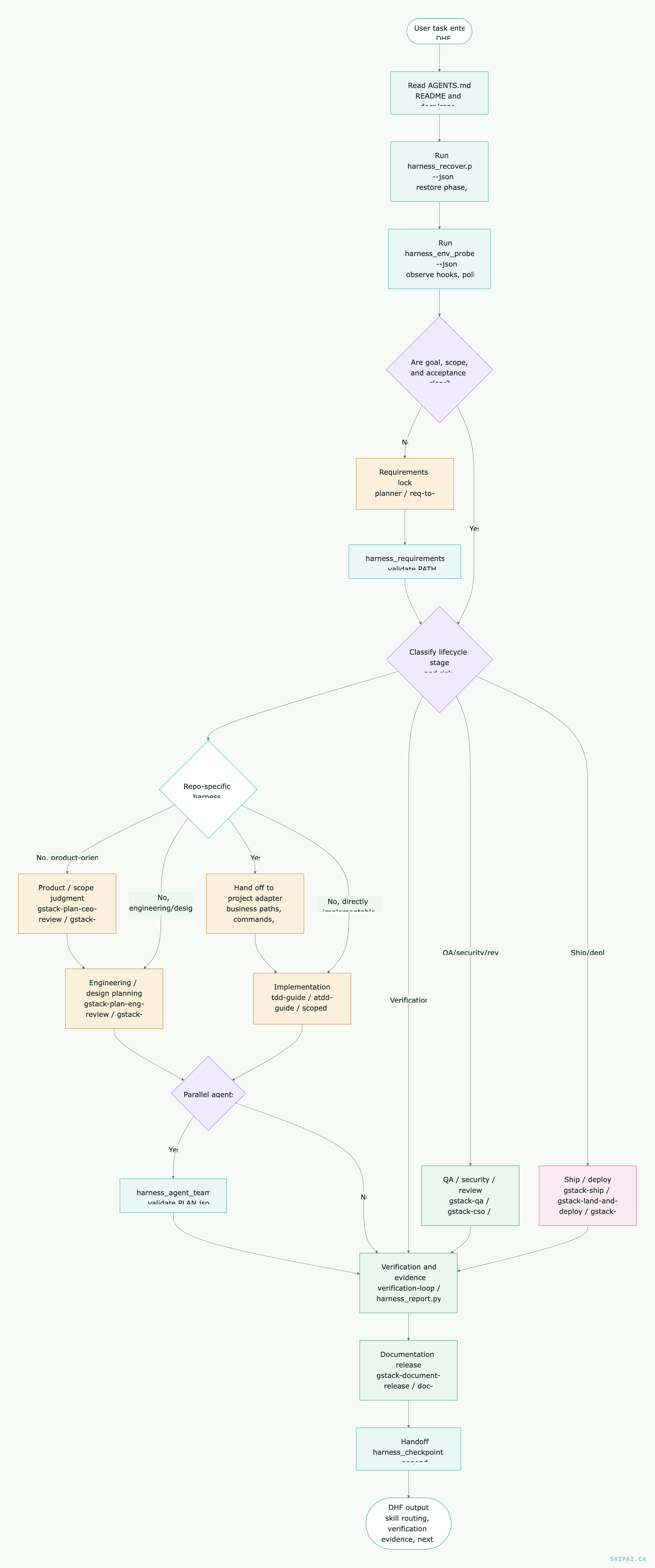
Recommended learning sequence: Beginner -> Lifecycle Flow -> Skill Routing Map -> Written Spec. The English path is now self-contained, with the written spec as the exact routing contract.
English Flow Map
A lightweight English lifecycle map showing how DHF moves from fact recovery and requirements through verification evidence and handoff.
Skill Routing Map
The public DHF skill and helper routing map, including domain docs, ADR checks, vertical slices, feedback loops, prototypes, durable briefs, and handoff gates.
Workflow Skills Matrix
A step-by-step inventory of every current DHF workflow step, the skills it uses, what each skill does, and the GitHub source link for each skill.
Written Routing Spec
The source-of-truth lifecycle guide for stage ownership, specialist skills, runtime helpers, agent briefs, evidence standards, and completion gates.
Share or switch language
Use these when the reader needs a presentation asset or the Chinese version of the same guide.
For maintainers
These are useful after the public concept is clear. They should not compete with the learning path.
Harness Runtime
The implementation contract for workflow state, helper scripts, evidence, checkpoints, permissions, hooks, and agent teams.
Classic Skill Map
Archive only. The older English visual remains available for comparison, but the status-style Skill Routing Map is the primary public path.